From Gary to Evansville, Indiana counties rely on annual assessments (Form 11) to set next year's tax bills. Multifamily and portfolio owners feel the hikes first — every extra dollar the assessor adds shaves real equity off your balance sheet. Yet fewer than 10% of Hoosier investors file an appeal each year, leaving millions on the table.
Cap-rate math: In Indianapolis (typical 5.5% cap), a $50k reduction in assessed value increases sale price potential by approximately $909k.
Why Multifamily Assessments Spike in Indiana
Income Approach Mandate (DLGF Guidelines) — Most urban counties (Marion, Allen, St. Joseph) weight NOI heavily. Strong rent bumps translate directly into higher assessments.
High-Water Sales — The 2024 record sale of Penrose on Mass in Indianapolis reset comps for Class A assets across Marion County.
Renovation Permits and Form 11 Catch-ups — Finishing basements or adding dog parks auto-flag parcels for reassessment under IC 6-1.1-4-13.
Data Errors on PRCs — We routinely see overstated unit counts or incorrect effective ages, especially in Lake and Vanderburgh Counties.
Critical Indiana Deadlines
Pay close attention to when your Form 11 is mailed — it determines your appeal window:
- Mailed before May 1: Your appeal deadline is June 15 (IC 6-1.1-15-1.1).
- Mailed May 1 or later: You have 45 days from the notice date to file.
Miss it and you're locked into the higher value for the 2025-pay-2026 cycle.
Five-Phase Indiana Appeal Framework
-
Portfolio Intake and Prioritization Export Form 11 PDFs from your county portals. Rank parcels by percent delta to market value.
-
Indiana-Centric Comp and Income Analysis
- Sales comps: Focus on arm's-length multifamily trades within the same taxing district.
- Income comps: When sales are thin, lean on rent rolls and Indiana Apartment Association vacancy data.
-
Evidence Packet Assembly Bundle PRCs, rent rolls, T-12s, cap-rate surveys from Indiana Bankers Association, and photos of deferred maintenance.
-
Form 130 Preparation and Filing One Form 130 per parcel — submit via county e-file portals where available or certified mail elsewhere.
-
Informal Meetings and PTABOA Hearings Counties like Hamilton hold virtual Zoom meetings; others require in-person attendance. Negotiated settlements before the board hearing save weeks.
How Smart Appeal AI Makes Indiana Bulk Appeals Easy
Gathering Indiana sales and rent data — Instead of spending 4 to 6 hours per parcel doing it yourself, Smart Appeal AI aggregates MLS, CoStar, and DLGF sales in seconds.
Re-entering owner info on Form 130s — Rather than spending 30 minutes per parcel, Smart Appeal AI auto-clones data across all parcels.
Tracking 92-county deadlines — No more manual calendars. Get a dashboard with county-specific countdowns and SMS alerts.
Filing logistics — Skip the trips to 3 or 4 courthouses. Use encrypted e-filing or their certified-mail concierge.
Cost — Instead of paying $450 for an appraisal plus staff time, Smart Appeal AI charges a flat $75 per parcel.
Success Snapshot: 2024 PTABOA Season
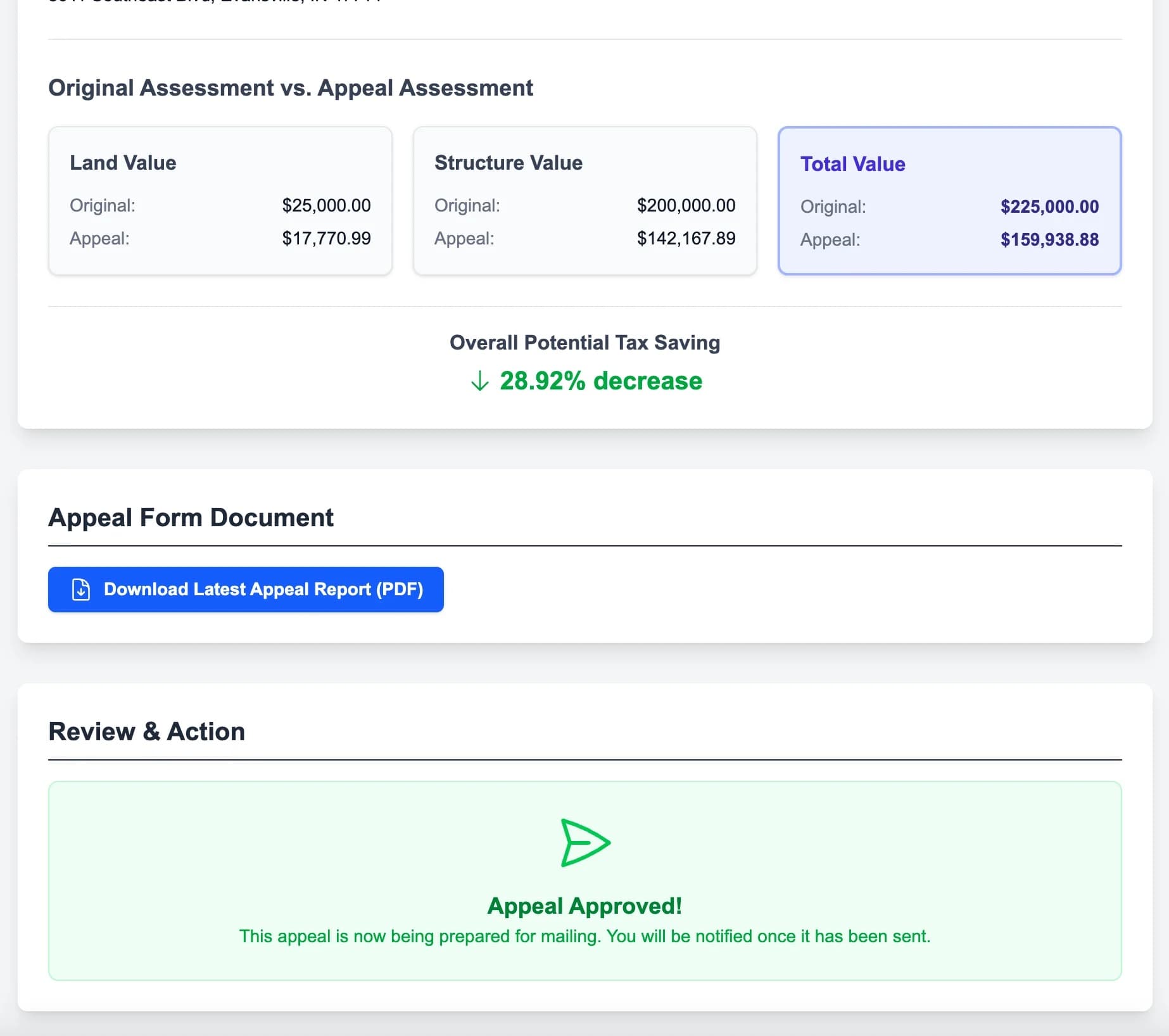
- Evansville 18-unit: Assessed at $1.92M, reduced to $1.48M (a 23% reduction)
- South Bend 44-unit: Assessed at $3.7M, reduced to $2.9M (a 21% reduction)
- Total annual tax savings: $29k
- Equity added at 6% cap rate: $483k
Three-Step Fast Track for Indiana Portfolios
- Upload basic property details to Smart Appeal AI.
- Review and Approve consolidated evidence packets tailored to each county's rules.
- E-Sign and Relax — they file, and text you status updates.
Total investor time: approximately 15 minutes.